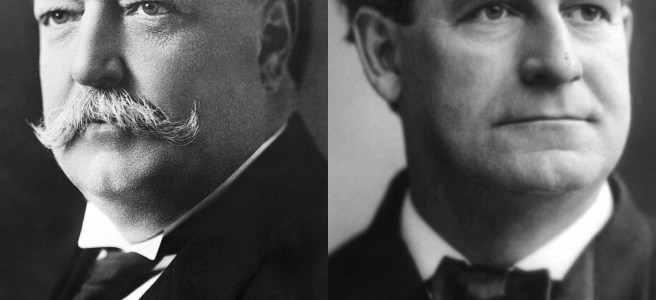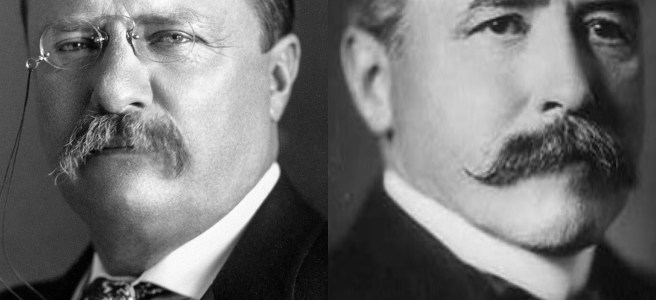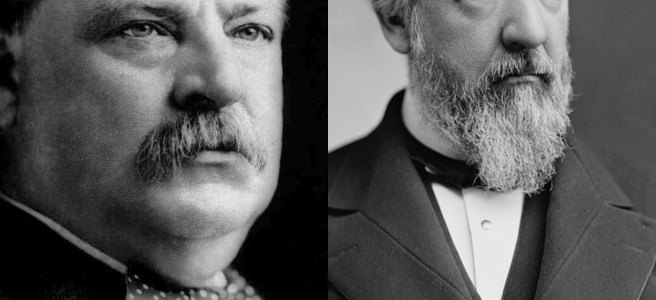
Woodrow Wilson was the first Democratic president since Grover Cleveland, and the first Southern president since Andrew Johnson. But his victory was a result of Theodore Roosevelt’s split with the Republican Party. Could Wilson hold onto power while keeping the US out of Europe's Great War?
Tag: elections
1912 – WILLIAM H. TAFT VS WOODROW WILSON VS THEODORE ROOSEVELT
After leaving his hand-picked successor, William Taft, in charge of the White House, Teddy Roosevelt traveled to Africa for a hunting trip. He intended to give his friend space to lead the country his own way. But keeping the progressive faction happy was more difficult than it seemed. Roosevelt's return to the US threatened the stability of the Republican Party and changed politics forever.
1908 – WILLIAM H. TAFT VS WILLIAM JENNINGS BRYAN
After one of the most decisive presidential victories of all time, Teddy Roosevelt promised not to seek a third term in office. But that didn't mean he was going away. Could Roosevelt's influence help keep Republicans in power?
1904 – THEODORE ROOSEVELT VS ALTON B. PARKER
In 1904, Democrats were torn between their progressive and conservative factions as they faced an erratic Republican president. Sound familiar? Let’s see how this one turned out!
1900 – WILLIAM MCKINLEY VS WILLIAM JENNINGS BRYAN, pt. II – TWENTIETH CENTURY REMATCH!
So long, 1800s! The century of Jefferson, Jackson, and Lincoln was coming to an end. William McKinley's decisive victory in the last election affirmed the Gold Standard as voters' preferred solution to the latest economic depression. Would they want McKinley to stay and lead them into the Twentieth Century?
1896 – WILLIAM MCKINLEY VS WILLIAM JENNINGS BRYAN
Right at the end of Benjamin Harrison’s term, the US entered yet another economic depression. The Panic of 1893 sent American life into a tailspin, deepening the monetary debate. Free Silver threatened to tear apart both parties. Could gold supporters hold out?
THIRD PARTY SYSTEM RECAP!
When the Whig Party split over slavery in the 1850s, there was an open position for the main rival of the Democrats. The “radical” Republican Party beat out the Know Nothings to fill the void. Their mere existence led to secession and Civil War. From humble beginnings, the Republican Party became the dominant political force of the late Nineteenth Century. The “Third Party System,” ranging from 1856-1894, encompasses the Civil War, Reconstruction, and the Gilded Age.
1892 – GROVER CLEVELAND VS BENJAMIN HARRISON, pt. II (ALSO VS JAMES WEAVER)
Don’t worry, you didn’t click the wrong post! In 1892, Grover Cleveland was back for revenge against the man who dethroned him. But the real action was in the People's Party, whose army of farmers aimed to disrupt the status quo!
1888 – GROVER CLEVELAND VS BENJAMIN HARRISON
It had been twenty years since a Democrat last occupied the White House. Grover Cleveland ran on a platform of integrity and reform. Would his vision be popular enough for the Democrats to win two presidential elections in a row?
1884 – GROVER CLEVELAND VS JAMES BLAINE – ALSO FEATURING: ARTHUR’S REDEMPTION!
The Half-Breed reformers in the Republican Party had another win with the election of President James A. Garfield. He was ready to finish the job President Hayes started on civil service reform. But Stalwarts like Vice President Chester A. Arthur were intent on maintaining the morally questionable Spoils System. Meanwhile, the Democrats were preparing to make their case as the true party of integrity.