
We’re all undoubtably feeling a lot of anxiety about the 2024 election. Rather than recite the events of the past few months or speculate on the unknowable results, I figured my extensive knowledge of past presidents would be best used to add some historical flavor to your slate of political content. You’ve probably gathered that a recurring theme of my blog is that, in many ways, a lot of current events that feel like novel developments actually have close historical parallels. Nothing can predict the future, but these elections might help you contextualize the significance of this week’s events.
1828 — John Quincy Adams vs. Andrew Jackson

In the 1820s, the United States was undergoing its first major political realignment. The reign of the Founding Fathers was over. President James Monroe’s Era of Good Feelings gave way to an economic depression and intense geographic fighting, resulting in the Missouri Compromise. Importantly, many states were now selecting their presidential electors by statewide popular vote, rather than retraining that power within their legislatures. Voters suddenly had a lot more power (white men only).
1828 was largely an echo of the 1824 election, when several major candidates competed to be Monroe’s successor. The country was extremely divided. No candidate won the electoral college outright, leaving the decision to the House of Representatives. The two frontrunners were Secretary of State John Quincy Adams and General Andrew Jackson. As a lifelong public servant and the son of the second president, Adams represented the political establishment. Self-made man and war hero Jackson, on the other hand, was seen as the champion of the common man. He was not afraid to speak his mind and was intensely critical of the politicians who had mishandled the recent economic downturn. Ultimately, Adams’ personal connections to Congress proved decisive, and he walked away the winner. He subsequently promoted Speaker of the House Henry Clay to Secretary of State, in what Jackson supporters labeled the “Corrupt Bargain.”
Adams had an ambitious agenda. He promoted the American System: 1) Infrastructure projects to build the West, 2) High tariffs to protect the industrial North, and 3) a National Bank to regulate the economy. His opposition in Congress made it difficult to pass legislation. In their view, infrastructure spending was just another way for politicians to funnel money to their cronies, tariffs hurt farmers and the working class, and the National Bank was a symbol of government overreach. Jackson wasted no time gathering support for his next presidential campaign — forming the basis of the Democratic Party. Adams was ahead of his time, but he was unpopular. Attacks on Jackson’s temperamental personality and violent military record did little to improve his chance at re-election.
The Results
Jackson won in a landslide. He used his authority to dismantle the National Bank, expand white settlements onto Native American land, and put faithful Democrats in positions of power. Jackson remained popular throughout his two terms in office, but he left his successor, Martin Van Buren, an economic depression. For his part, Adams went on to become the only president to return to Congress after serving as Commander in Chief. He became a vocal antislavery advocate in the House.
Trump’s Strategy
Capitalize on voters’ distrust of the political establishment. Turn the opposition’s agenda into symbols of corruption. Lead the party as a strongman who demands loyalty over ideological purity.
1884 — James Blaine vs. Grover Cleveland

Following the Civil War, Republicans dominated federal elections for several decades, but their propensity for government corruption gave northern Democrats a chance to mount a comeback. Republicans were split between the Stalwarts, who defended the “Spoils System” of awarding government jobs to party loyalists, and the Half-Breed reformers. When President James Garfield was assassinated by a disgruntled office-seeker in 1881, it made the issue even more salient. Former Secretary of State James Blaine won the party’s 1884 presidential nomination as a moderate reformer, but he was haunted by accusations of corruption during his time in Ulysses S. Grant’s administration — specifically, for accepting bribes from railroad companies.
To counter the scandal-prone Blaine, Democrats nominated Grover Cleveland, the governor of New York. Cleveland was a relative newcomer to politics. He had a clean record and was known for opposing his own party’s political machine, Tammany Hall. The election proved to be extremely close, and the candidates’ characters became a key issue. Despite his reputation, Cleveland was discovered to be hiding a scandal of his own — an illegitimate child. The campaign’s turning point, however, came at Blaine’s expense. At an event the candidate attended in New York, then a vital swing state, a Protestant minister gave a speech criticizing Democrats as the party of “rum, Romanism, and rebellion.” Irish Catholic voters were quick to turn against Blaine when they heard this faux pas. The candidate’s apology came too late to change their mind.
The Results
Cleveland won New York, and thus the election, by just over 1,000 votes. As president, he was known for his economic conservatism and affinity for vetoes. After his re-election in 1892 (nonconsecutive terms!), the Democratic Party split over populist demands for increased government support during an economic depression.
Harris’ Strategy
Stay on-message and let your flawed opponent beat themself. Candidates with extreme supporters will eventually show their true colors. In a close election, one insult against a key demographic could be the deciding factor in a swing state.
1948 — Harry Truman vs. Thomas Dewey
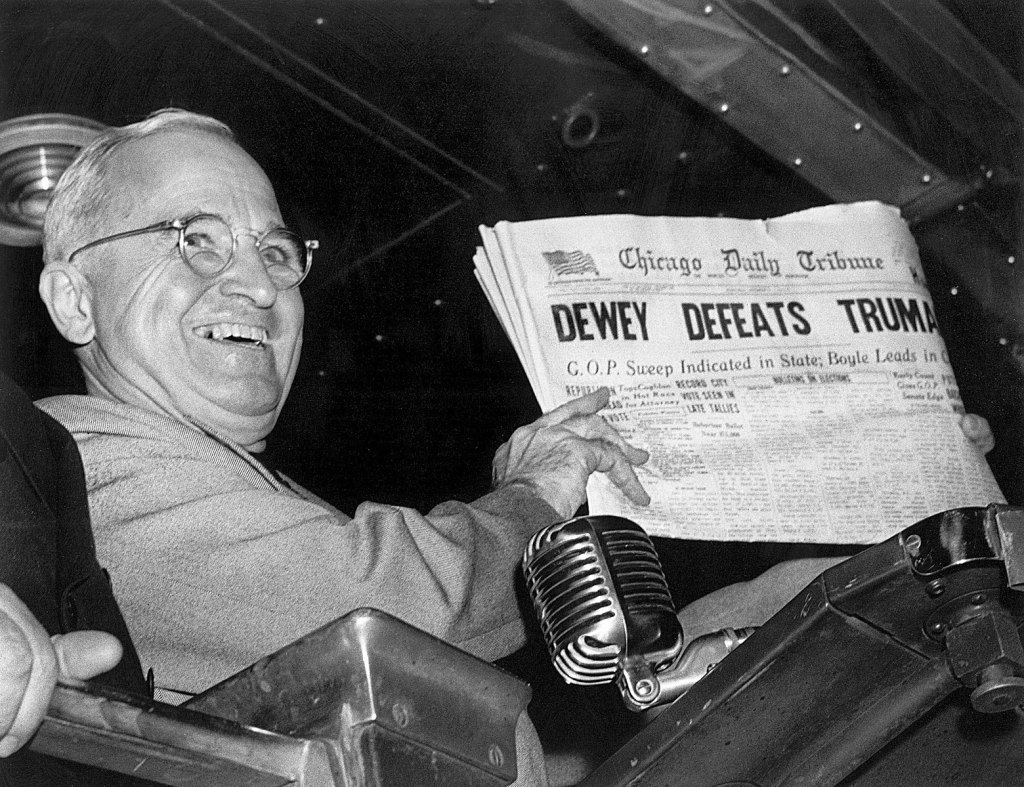
President Franklin D. Roosevelt won his unprecedented fourth presidential election in 1944. Unfortunately, he died in April the following year, leaving his successor, Harry Truman, to oversee the final months of World War II. Truman had the bittersweet task of restoring normalcy during peacetime. While rebuilding cities and fighting back Communists in Europe, he faced an economic recession at home due to the influx of working-age men returning from war. Republicans in Congress made it difficult for him to address the nation’s needs. He entered 1948 with a 36% approval rating. Despite this disadvantage, Truman was able to fend off challengers and retrain his party’s nomination.
Republicans felt they had a chance to win their first presidential election in sixteen years. Their nominee was the moderate governor of New York, Thomas Dewey. As the clear frontrunner, Dewey took no chances. He remained vague on policy specifics and often spoke in generalities, such as, “Our future lies ahead of us.” Truman’s counter-strategy was to focus his attacks on Republicans in Congress, rather than his presidential opponent. He called for a special session of Congress to vote on a slate of progressive legislation. When none were passed, he labeled them the “Do-Nothing Congress.” Political stunts aside, most observers still considered Dewey to be the most likely winner.
The Results
Eager to publish their Election Day headlines, newspapers preemtively declared that “Dewey defeat[ed] Truman.” In reality, Truman snuck out a win thanks to the support of heartland farmers. The President had more success passing modest expansions of the New Deal in his second term, but still struggled to manage a sluggish economy. Meanwhile, tensions with the USSR continued to sour, setting the stage for the Cold War.
Harris’ Strategy
A low approval rating for an incumbent party can be overcome by reminding voters of the unpopular policies of the opposition. Voters’ motivations can be frustrating, but they’re not stupid. Give them a chance to understand how the other party has, and will continue to, make their lives worse. Don’t let a personality contest overshadow basic issue messaging.
1964 — Lyndon B. Johnson vs. Barry Goldwater

President John F. Kennedy entered office with an ambitious agenda designed to propel America into the future. His time in office came to be defined by crises, from the Cold War to the Civil Rights movement. A lot of work was left to be done when Lyndon B. Johnson took the oath of office following Kennedy’s assassination. Most importantly, Johnson used the promise of cementing Kennedy’s legacy to pass the Civil Rights Act of 1964, officially banning segregation in public facilities. He also expanded military action in Vietnam, following the attack on American ships in the Gulf of Tonkin. Johnson only faced minor opposition in his bid for the Democratic Party’s presidential nomination in 1964.
The Democratic Party’s embrace of Civil Rights opened the door for a social conservative takeover of the Republican Party. Their national convention was dominated by supporters of Arizona Senator Barry Goldwater, an outspoken critic of the more moderate faction of the party, including former President Dwight Eisenhower. After securing the party’s nomination, he selected another social conservative as his running mate, signaling his intention to forgo any attempts at unity. Goldwater ran on a far-right policy agenda promising to undo the New Deal, rollback Civil Rights legislation, and most controversially, use nuclear weapons to win the Cold War. Johnson’s campaign was eager to highlight his opponent’s extreme views. They mocked the Republicans slogan, “In your heart, you know he’s right,” by adding, “In your guts, you know he’s nuts.” With possibly the most effective campaign ad of all time, they juxtaposed a young girl counting flower pedals with a countdown to nuclear detonation. They argued that only Johnson could be trusted to avoid a world-ending military conflict.
The Results
Their strategy worked and Johnson won in a landslide. But despite major successes with social legislation, Johnson’s second term was overshadowed by the public’s growing displeasure with the Vietnam War. Goldwater’s extreme rhetoric found a new home in the campaigns of two more cunning Republican candidates, Richard Nixon and Ronald Reagan.
Harris’ Strategy
Highlight the extreme policies of your opponent to make the choice clear to voters. Be a steady hand while the opposition party is divided. But remember, winning one election does not mean those beliefs are vanquished forever. Only good governance can ultimately keep extremism at bay.
1980 — Jimmy Carter vs. Ronald Reagan

Georgia Governor Jimmy Carter won the 1976 presidential election as a scandal free outsider in the wake of Richard Nixon’s Watergate scandal. Unfortunately, his outsider status also meant that he wasn’t skilled at the day-to-day politicking that was the norm in Washington, DC. From the beginning of his term, he had a contentious relationship with Congress and the media. Carter struggled to enact his agenda during an economic downturn — specifically, the low-productivity, high-inflation trend known as “Stagflation.” To make matters worse, Carter seemingly blamed the country’s poor economic performance on the public’s lack of confidence in his televised “economic malaise” speech. Despite his low approval rating, Carter survived a tough primary challenge from Massachusetts Senator Ted Kennedy.
The Watergate scandal left the Republican Party in a precarious position. Like Carter, Nixon’s successor, Gerald Ford, had been plagued by a struggling economy and a poor relationship with the press. His primary opponent, former California Governor Ronald Reagan, was popular but fell short of defeating the incumbent. Now, four years later, Reagan was the clear choice for the 1980 nomination. Reagan was a true conservative who promoted small government with low taxes at home, and a tough foreign policy against Communism abroad. Importantly, Reagan also represented a return of optimism and patriotism. He rejected the notion that the country faced a “crisis of confidence,” instead placing the blame with establishment leaders. His background as an actor and radio personality made him particularly adept at delivering this message. Carter suffered from a more negative reputation than he likely deserved, but the key question posed by the Reagan campaign, “Are you better off than you were four years ago?” was a fatal blow to his re-election chances.
The Results
Reagan won in a landslide, expanding the Republican coalition to include more working-class voters. As president, he enacted many of the conservative economic policies he campaigned on. His policy of high interest rates was tough on poor families, but was ultimately vindicated by an economic boom shortly before his re-election campaign. Unfortunately, his aversion to unions and propensity of deregulation set the stage for economic crises to come.
Trump’s Strategy
Voters hate inflation more than just about any other economic outcome. Hit hard on the economic message and take advantage of pessimism on the other side.
2000 — Al Gore vs. George W. Bush

Throughout the 1990s, Bill Clinton proved himself to be a popular and effective president, presiding over a growing economy and a government surplus. Unfortunately, he was plagued by his own personal failings and constant scandals, culminating in the Monica Lewinsky affair. Clinton survived impeachment, but it was unclear how the Democratic Party would handle his legacy going forward. Vice President Al Gore easily won the party’s 2000 presidential nomination as the scandal-free heir to the Clinton Administration.
After two presidential losses, Republicans were desperate to find their next Ronald Reagan. The frontrunner for the nomination was Texas Governor George W. Bush, son of the 41st president. As a born-again Christian, Bush represented the religious faction of the Republican Party. His “compassionate conservative” image implied a softer touch than many other economic conservatives. With a little help from his father’s political connections, and money, Bush was able to defeat moderate Arizona Senator John McCain in the primaries. Despite his bad habit of verbal gaffes, many voters considered him the kind of guy you’d want to have a beer with.
The election proved to be extremely close. At the end of Election Day, voters were far from learning who had won. The answer depended on Florida, where only a few hundred votes separated the candidates — and Bush’s brother was the governor. The logistics of the recount became the subject of a Supreme Court case. The conservative majority decided to halt the recount, leaving Bush as the winner. Gore graciously conceded.
The Results
Bush’s presidency started off mostly as expected as he attempted to enact his conservative agenda. The situation, of course, changed quickly following the September 11th terrorist attacks. Bush then benefitted from the high approval rating of any modern president, ensuring his re-election. His second term ended in disaster, however, as the public became increasing critical of the Iraq War, and the country faced the worst economic downturn since the Great Depression. Bush left office extremely unpopular — leaving his party without a clear leader.
Trump’s Strategy
Electoral chaos is good for Republicans, especially when there’s a conservative majority on the Supreme Court.
Parting Thoughts
DON’T FORGET TO VOTE!!!
Images
I. President’s Levee, 1841 — Robert Cruickshank, Library of Congress / Wikimedia Commons / Public Domain
II. Phryne before the Chicago Tribunal, 1884 — Bernhard Gillam, Library of Congress / Wikimedia Commons / Public Domain
III. Dewey Defeats Truman, 1948 — Byron H. Rollins / Wikimedia Commons / Public Domain
IV. Screenshot from Daisy Ad, 1964 — Lyndon B. Johnson’s Presidential Campaign / Wikimedia Commons / Public Domain
V. President Ronald Reagan Addresses the Nation from the Oval Office on Tax Reduction Legislation, 1981 — White House Photographic Collection / Wikimedia Commons / Public Domain
VI. Butterfly Ballot, 2000 — OWN Network / Wikimedia Commons / Public Domain
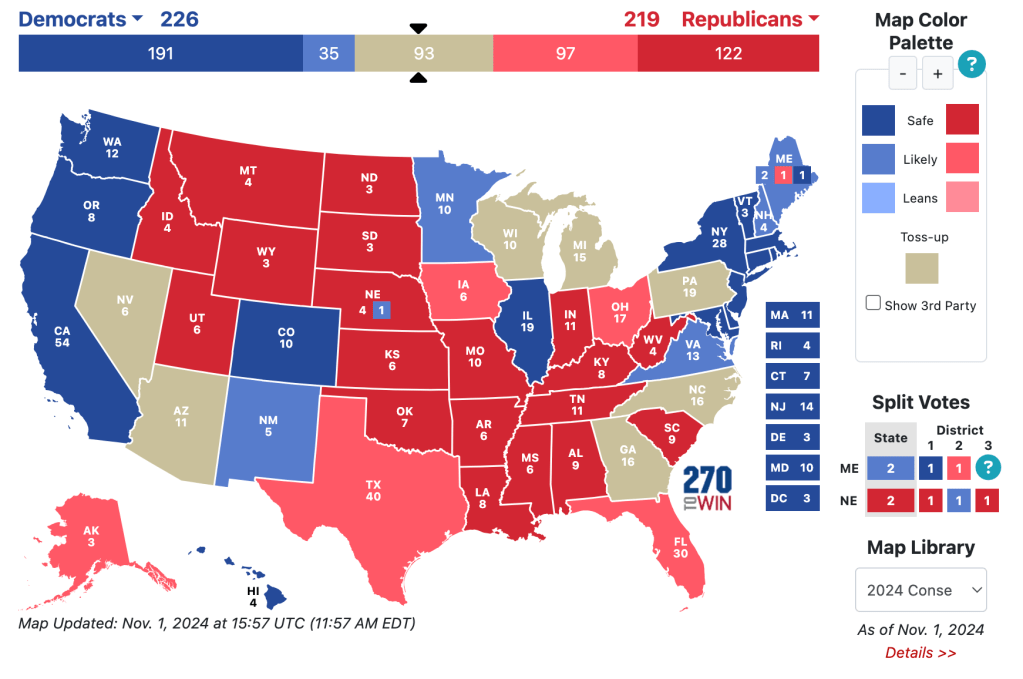
VII. 2024 Presidential Election Interactive Map, November 1, 2024 — 270towin.com.

 Election Tuesdays


.jpg)