By rejecting the James Monroe’s treaty with Great Britain, President Thomas Jefferson and Secretary of State James Madison made the War of 1812 inevitable. But the official declaration of war was still several years away. Were the right people in charge?
Background
James Madison succeeded Jefferson as president following the 1808 election. Like his predecessor, he was a plantation-owning Virginian who believed in small government. He was one of the main authors of both the Constitution and the Bill of Rights. He served in the House of Representatives before joining Jefferson’s Cabinet. As president, Madison inherited a crisis with Great Britain, whose navy was using the Napoleonic Wars as an excuse to attack American merchant ships. When diplomatic negotiations failed, Jefferson had responded with the unpopular Embargo Act. The American economy suffered, and the British were no closer to stopping their attacks. Madison subsequently repealed the embargo and resumed peace talks in a final effort to avert war.


Unfortunately, the situation only worsened. Attacks by the British Navy continued. The conflict also escalated on land, as American settlers began pushing past the country’s borders. In the South, rural farmers demanded the annexation of West Florida from Spain, a British ally. They argued, as did Jefferson and Madison, that the territory had been part of the Louisiana Purchase, although it was unclear if France had the right to sell it at the time. Americans attacked Spanish forts in the region. Meanwhile, fighting also increased with Native Americans in the West. While Native American tribes had many different (and shifting) allegiances, most were more friendly with the British than the Americans, who were rapidly encroaching on their land. The most famous battle was between Tecumseh and Indiana Territorial Governor William Henry Harrison at the Tippecanoe River.1 Finally, tensions rose along the nebulous border with Canada, leading some Americans to speculate that their northern neighbors were primed for liberation.
It seemed as if both the British and the Americans hungered for war. A faction of Democratic-Republicans in Congress, mainly from the South and West, demanded more aggressive action from the Madison Administration. They were led by Kentucky Representative Henry Clay and South Carolina Representative John C. Calhoun.2 Congress became divided between War Hawks and Doves.3
Major Issues
In addition to the ongoing foreign policy crisis, President Madison struggled to staff his Cabinet. He planned to promote Jefferson’s Secretary of Treasury, Albert Gallatin, to Secretary of State, but faced unexpected opposition from Congress. An influential block of Democratic-Republican senators, known as “The Invisibles,” demanded that Madison make appointments based on patronage. Gallatin remained at Treasury and Madison instead selected Robert Smith, the brother of one of the aforementioned powerful senators, as his Secretary of State.
Smith was ineffective and untrustworthy in his ill-gotten position. He was extremely passive when negotiating with the British and often sided with them over his own government. He once told a British diplomat that they “had a right to complain” about Madison’s policies. Madison soon hoped to replace Smith, but doing so would risk backlash from the Invisibles. They had already threatened to leave the party if he did not follow their demands. There was only one choice that Madison felt that he could get past the Invisibles: James Monroe. As the influential negotiator behind the Louisiana Purchase and the failed Monroe-Pinkney Treaty, Monroe had an extensive diplomatic resume. Unfortunately, Madison’s opposition to the treaty, and his subsequent attempt to push him out of Democratic-Republican politics, had left the two on bad terms.4
~The Time Warp~

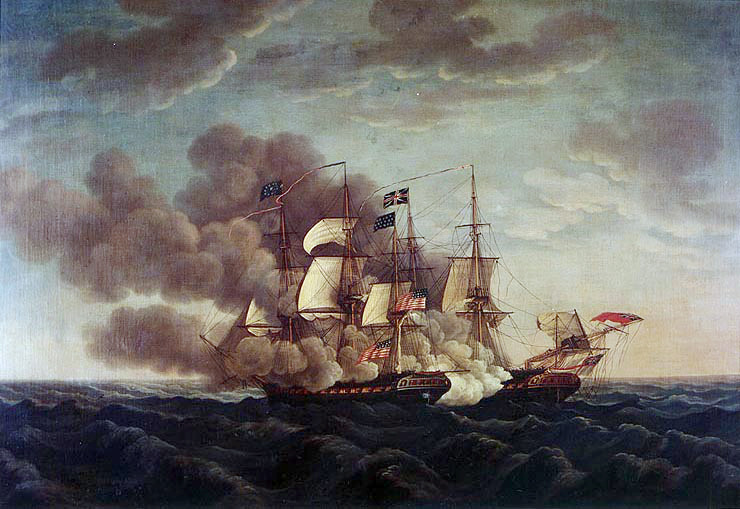
Madison let his ego get the best of him and chose not to appoint Monroe as Secretary of State.5 Smith kept his job and continued to fumble his negotiations with the British. As attacks on American ships and settlers worsened, Madison looked weak. War Hawks demanded a strong response and threatened to challenge Madison’s re-election campaign.6 The conflict reached an inflection point when British troops seized Fort Detroit in the summer of 1812. Similarly, in the North Atlantic, the USS Constitution faced off against the HMS Guerriere in the first major naval battle of the war. The Constitution fought valiantly, but was ultimately outmatched and destroyed. When news of the loss reached the mainland, American morale plummeted.7
The Candidates
Despite the intra-party threats to his presidency, Madison retained the Democratic-Republican nomination for the election of 1812, with one minor change. Vice President George Clinton, originally from New York, died earlier in the year. He was replaced by Massachusetts Governor Elbridge Gerry.8 Like Clinton, he was considered too old to run for the presidency himself.
Federalists, who had the strongest support in New England, had been vocally opposed to the war since the beginning. As the opposition party, they were no strangers to arguing against the Democratic-Republicans. But their constituents had also been the hardest hit by Jefferson’s Embargo Act. They felt that the Napoleonic Wars in Europe could have been an economic benefit for the US, an advantage that had been squandered by the last two administrations. Moreover, they were not eager to fight for their northern borders with Canada. Although they had made strong electoral gains during Madison’s term, they still did not have the national strength to make a competitive challenge for the presidency.
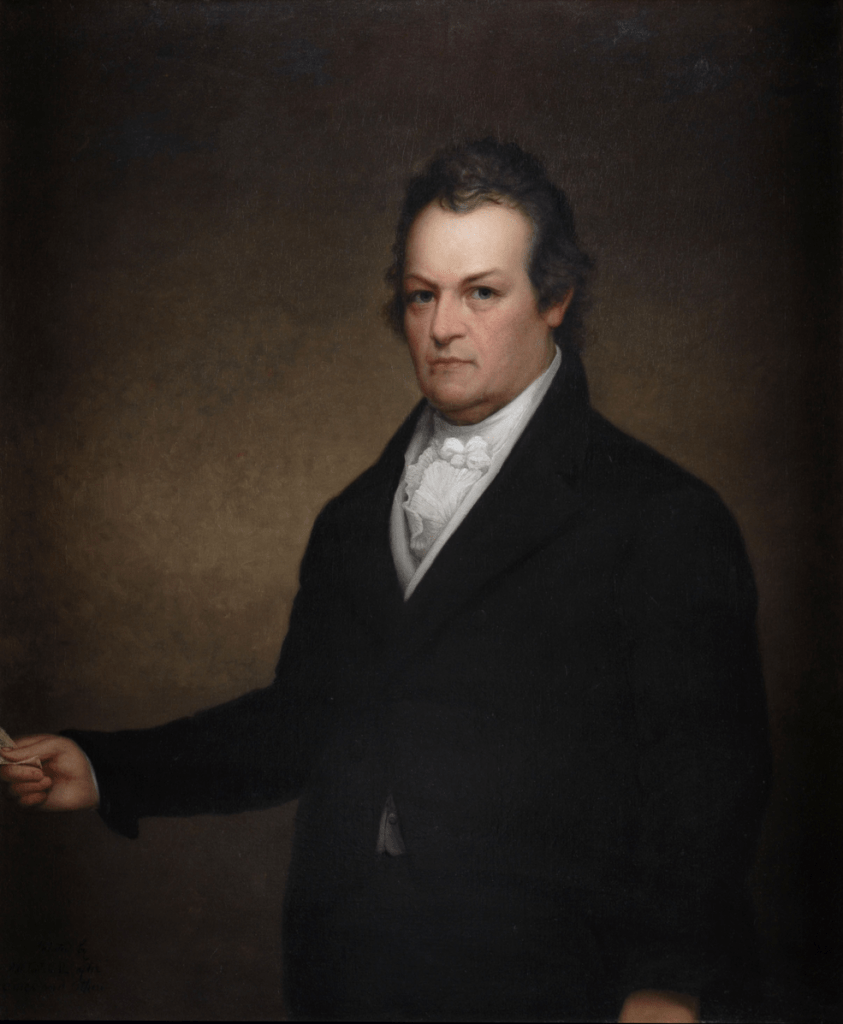
Instead, the Federalists endorsed a split-ticket candidate with unhappy Democratic-Republicans. Their candidate was DeWitt Clinton, nephew the late vice president and also a New Yorker.9 Clinton was sly in his campaign strategy. He told Federalists he would end the war, while telling Democratic-Republicans he would win the war. He attacked Madison from all sides, but it was unclear if he could get away with playing both sides.
The Winner
DeWitt Clinton won! Madison had made too many bad decisions and looked weak in the face of the European aggression. By sticking with Smith, he had limited options, alienating both the War Hawks and Doves. Although his strategy was risky, Clinton successfully combined his strength in the North10 with disaffected Democratic-Republicans in the Mid-Atlantic and Western states. Together, the candidates broke two feats set by John Adams: Madison was the second one-term president, and Clinton was the second Northerner.
The Future
The war effort continued to stumble forward. While Clinton had served as a unifying symbol of disapproval against the Madison Administration for Hawks and Doves, he did not actually have an effective coalition in Congress. His campaign promises quickly caught up to him, and both sides were dissatisfied. Clinton struggled to hold the country together while the losses on the battlefield added up.
What Did It Say About America?
The War of 1812 was a major test of America’s readiness for war. And, as it turns out, America wasn’t really ready for war! The nation had bitter political and geographical divisions that had been brewing since the Revolution. In both realities, it would take several years of fighting until America had a formidable military force.
Was It The Right Decision?
Not really. While Madison wasn’t the strongest president, Clinton was an opportunist who did not have a real vision for the country.11 Together with Monroe, Madison would eventually lead the nation to victory,12 and America would finally move past its rivalry with Great Britain.
- The battle earned Harrison the nickname “Old Tippecanoe,” most famously referenced in his 1840 presidential campaign slogan, “Tippecanoe and Tyler too.” ↩︎
- Clay and Calhoun would go on to become two of the most influential politicians in American history. Clay was the face of the Whig Party (the opposition to Andrew Jackson’s Democrats) while Calhoun was a major proponent of states’ rights and the expansion of slavery. ↩︎
- Terms we still use today! ↩︎
- In real life, Monroe had been careful not to promote further party divisions after losing the presidential nomination in 1808. Jefferson helped mend the friendship between Madison and Monroe over the next several years. ↩︎
- Of course, in our timeline, Madison did choose Monroe to replace Smith. He promised Monroe that he would be free to speak his mind, and that “differences of opinion” would be welcome in his Cabinet. ↩︎
- Madison and Monroe used rumors that the British were attempting to annex New England to Canada as justification for the build-up to war. The rumors turned out to be mostly false, but the War Hawks were fired up anyways. ↩︎
- In our world, Fort Detroit was also captured by the British, but the USS Constitution won, earning it the nickname “Old Ironsides.” It was one of the only positive things Madison could point to in his re-election campaign. The ship is still around today and is docked in Boston Harbor! ↩︎
- As governor, Gerry signed off on a new redistricting map that was heavily favorable to the Democratic-Republicans. A political cartoon compared one particularly contorted district to a salamander, coining the term “gerrymander.” It’s also worth noting, Gerry was pronounced like “Gary.” ↩︎
- Clinton later became governor of New York. He was best known for funding the Erie Canal. ↩︎
- Many Northerners were simply eager to break the South’s grip on the presidency, no matter their candidate’s political affiliation. ↩︎
- He could be compared to another famous New Yorker from the era — Aaron Burr! ↩︎
- Uhh, more like stalemate, actually. ↩︎
Images
I. Combat between USS Constitution and HMS Guerriere — Michel Felice Corne / Wikimedia Commons / Public Domain
II. Map of Eastern Canada during the War of 1812, 1829 — Thomas Kensett / Wikimedia Commons / Public Domain
III. A New Map of Part of the United States of North America, Containing the Carolinas and Georgia, also the Floridas and Part of the Bahama Islands &c., 1805 — John Cary, Geographicus Rare Antique Maps / Wikimedia Commons / Public Domain
IV. Siege of Detroit — John Clifton Henry Forster / Wikimedia Commons / Public Domain
V. Official Gubernatorial portrait of DeWitt Clinton — Asa Twitchell / Wikimedia Commons / Public Domain
Resources
McGrath, Tim. James Monroe: A Life. Penguin Random House, 2020.

 Election Tuesdays


