

This post will be a little different because I want to talk about the present! It’s like history, except it’s still happening.
As you probably know, the first Republican primary debate was just a few weeks ago. It went about how you would expect. Despite their differences, the candidates agreed that Joe Biden and the Democrats were destroying the country. But beyond my objections to their world views, there was a certain lack of substance to the debate that caught my attention. Rarely did the candidates address how their ideas would be put into place, or how they would achieve their intended effects. In contrast, the Democratic primary debates of 2020 (a campaign I followed with great enthusiasm) felt very policy-heavy. The candidates often went into extreme detail on their proposals, and a lot of time was spent arguing about minor differences.
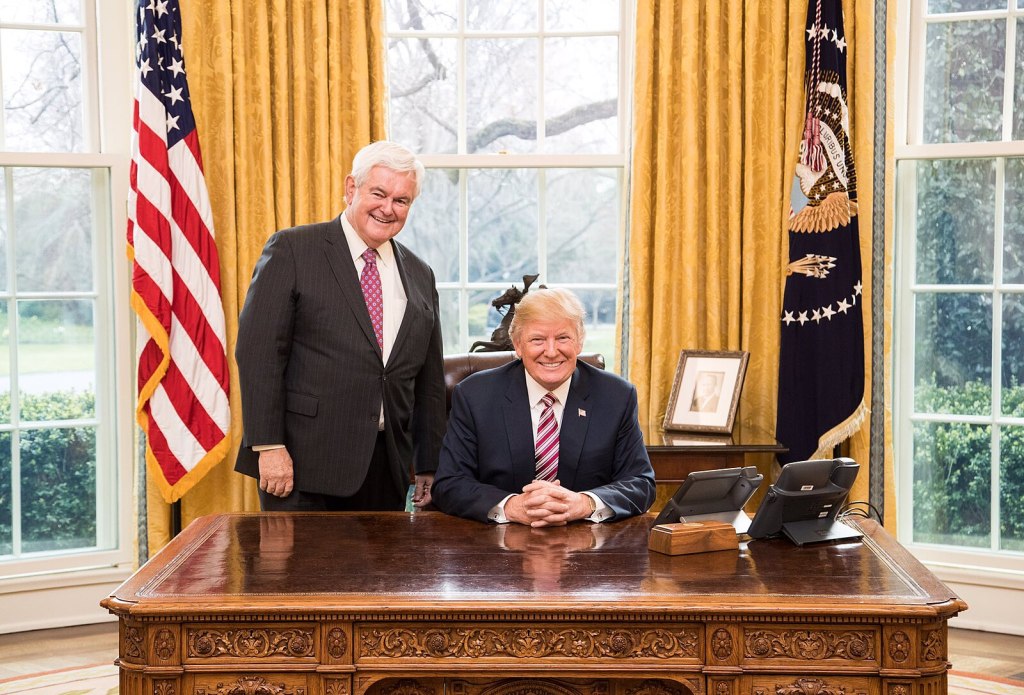
This distinction brought to my mind an interview with former Speaker of the House Newt Gingrich from 2016. He was speaking with CNN’s Alisyn Camerota on the morning after Trump’s acceptance speech at the Republican National Convention. The speech had been predictably controversial. Trump rallied against all of the terrible things that the political establishment had done to this country — including, but not limited to, political correctness, illegal immigration, and the trade deficit. “Not only have our citizens endured domestic disaster,” he argued, “but they’ve lived through one international humiliation after another — ONE AFTER ANOTHER! This is the legacy of Hillary Clinton: death, destruction, terrorism, and WEAKNESS.” Memorably, Trump promised that he alone could fix it.
In the interview, Camerota asked Gingrich if he felt that Trump’s speech had been too negative. Could it be alienating to voters? It was certainly a far cry from the sunny optimism of Ronald Reagan, for example. Gingrich’s response was that everything really was bad, and that any evidence of the contrary was meaningless in the minds of angry conservative voters. Their conversation went as follows (emphasis my own):
Alisyn Camerota: “Some people think it was too bleak, that he painted too bleak a picture of where we are in America. Crime is down in America. Violent crime is down. The economy is ticking up.”
Newt Gingrich: “It is not down— It is not down in the biggest cities.”
…
AC: “But it is— we are safer. And it is down.”
NG: “No, that’s your view.”
AC: “Those are facts.”
NG: “I just told— no.”
AC: “Those are facts. Statistics.”
NG: “But what I said is also a fact. The average American feels— when you can walk into a nightclub and get killed, when you can go to a party in a county government building and get killed… people don’t think that their government’s protecting them. When you have Baltimore, when you have policemen ambushed in Dallas… Now, your view, I understand your view, it’s the— the current view is that liberals have a whole set of statistics which theoretically may be right, but it’s not where human beings are. People are frightened. People feel that their government has abandoned them. 25 million Americans have dropped out of the middle class according to Gallup.”
AC: “Yes, well that’s the economic figures that you’re saying, though, unemployment has ticked down. But what you’re saying is—”
NG: “Yeah, but—”
AC: “Hold on, Mr. Speaker— because you’re saying liberals use these numbers, they use this sort of magic math… these are the FBI statistics, they’re not a liberal organization. They’re a crime fighting organization.”
NG: “No. But what I said is equally true. People feel [said together] more threatened.”
AC: “Yes. They feel it, but the facts don’t support it.”
NG: “Fine. As a political candidate, I’ll go with how people feel, and I’ll let you go with the theoreticians.”
At the time, Gingrich’s response made me very mad — hence, why I still remember it years later. It went against everything I believed about politics. It was especially frustrating to think that Trump won the nomination (and soon after, the general election too) by taking advantage of how people feel, rather than relying on facts. But… given a little more time… I’ve become more accepting of the realities of voters’ feelings. The idea that a politician would appeal directly to voters’ feelings, no matter the facts, is not new. And it’s not going away. For better or worse, that’s not a bug of democracy. It’s a feature.
I want to write about this topic now because of the aforementioned Republican primaries. I want myself, and others, to think outside of their own political bubbles when analyzing this election. There are a lot of hot takes already flying around about the candidates, their campaigns, and the voters who will be choosing between them. Many of these takes are coming from the same media personalities who deeply misunderstood the dynamics of the 2016 presidential election. They believed that Newt Gingrich was wrong. Trump’s appeals to people’s feelings would backfire. The facts would win. Right?
Democrats and Republicans Are Different
Ok, I suppose that’s not exactly an attention-grabbing headline. There are plenty of obvious differences between the parties. However, on top of those surface-level characteristics, there are measurable distinctions in the values and motivations driving both voter bases.
In 2016, Vox co-founder Ezra Klein explored these differences at the height of the primaries. Klein noted the accounts of two MSNBC campaign reporters, respectively covering the Democratic and Republican races, as an introduction to the deeper dynamics at play. The reporters flipped jobs for a week and recorded the contrasts that stood out to them. Anecdotally, they found that Democratic voters were more likely to be motivated by specific policy issues that affected their lives, whereas Republicans had more abstract concerns, like “The Constitution.” Research from a few years prior supported their findings. Put simply, Democrats want to see the government, well, govern. They have a broad coalition of interest groups, each with their own specific policy demands. Naturally, their constituents expect reasonable compromise, followed by implementation. Republican voters are not so trusting of this process. They have less diverse interest groups, and they do not want to see compromise. Core values such as belief in small-government specifically require the federal government to not accomplish many of its goals. That can be frustrating to progressives who want to get things done, but it’s something that is innate to a lot of voters.
Similar research has shown a correlation between political views and the “Big Five Personality Traits.” Some psychologists use the Big Five to assess individual personalities. They include: openness to experience, conscientiousness, extroversion, agreeableness, and neuroticism. Importantly, taken at face value, none of these traits draw an obvious connection to political ideology. However, researchers have found two strong links — liberals tend to be more open to experiences, and conservatives tend to be more conscientious. This suggests that, for many voters, political ideology is derived from something deeper than economic circumstances or social class. It’s who they are.
Hindsight is 2020
As noted in my intro, the ongoing Republican race draws obvious comparisons to the 2020 Democratic primary. Those debates were very policy-focused, but did it really matter? Many arguments centered around legislation that had virtually no chance of passing in Congress. The Republican candidates, on the other hand, are all talk and no policy. They are eager to criticize the state of the country, without offering many substantive solutions. Political blogger Matthew Yglesias had similar complaints in a recent article.
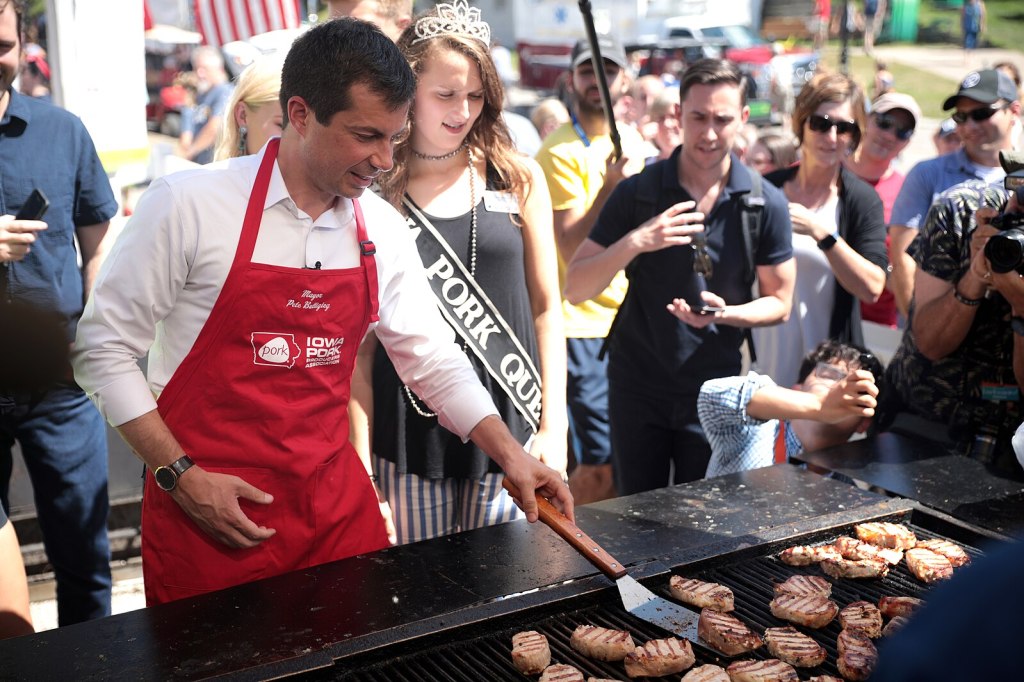
I was often frustrated by the 2020 Democratic primary because everyone seemed obsessed with disagreements that couldn’t possibly make any difference. Do you remember the argument about whether Buttigieg’s “Medicare for All Who Want It” proposal was left-wing enough or Bernie and Warren arguing about rival visions of a multi-trillion tax increase to pay for single-payer health care? There was a whole news cycle devoted to activists complaining that Beto O’Rourke’s $3.5 trillion climate investment package was too timid because he didn’t pledge to achieve net zero by 2030.
By contrast, the GOP primary field seems to have been completely de-contented.
The closest thing to a real forward-looking policy argument we saw at the debate last week was candidates circling around the idea of federal abortion bans. But all they were really doing was arguing over how pessimistic they should be about the congressional politics of a 12- or 15-week ban. They didn’t get into things the president actually has control over, like judicial nominations or FDA regulation of mifepristone. Nikki Haley criticized the CARES Act, which was interesting, but she didn’t really explain why, and nobody else on stage really criticized it. But that would be a topic to argue about: was Trump wrong to do fiscal stimulus? I get the sense that Republicans think nuclear energy is good. Do they have policy ideas about it? Why did the previous two GOP administrations not accomplish anything on this front despite impeccable pro-nuclear vibes?
To Democrats, over-analyzed and bloated policy ideas help them juggle the broad range of interest groups that make up their coalition. Republicans, instead, hold their party together by avoiding specifics and focusing on grievances. Unfortunately, this void leaves room for the loudest, most controversial candidates to dominate the debate stage. Donald Trump exploited this dynamic perfectly in 2016. In the most recent debate, it was Vivek Ramaswamy who attempted this tactic. He has since received a considerable bump in interest following his brash performance.
While, once again, it is incredibly frustrating to watch this play out from outside of the Republican coalition, it is worth considering that Republican politicians may be more directly connected to the will of their voters than Democrats. At the end of the day, large portions of both parties’ debates were ultimately immaterial. In fact, the eventual winner of the 2020 primary, and our current president, was arguably the candidate least plugged-in to social media driven arguments over intricate policy details. Biden’s strength was being personable and relatable, while others were consumed by facts and figures.
I Alone Can Fix It
In my view, both parties learned the wrong lessons from Trump’s 2016 victory. The winning strategy seemed to be turning out the extreme ends of each voter base. Republicans believed voters wanted more far-right politicians who made mean-spirited attacks on their opponents. That’s the mold that many current presidential candidates, like Ron DeSantis, appear to be following. Far-left Democrats instead yearned for their own version of Trump: an establishment-breaking populist who could remake their party’s coalition. Even moderate Democrats considered all Trump voters to be extremists that they could never win again.
In reality, Trump had ditched many of the Republicans’ least popular policy stances in his 2016 campaign. Unlike Mitt Romney, he did not promise to cut Social Security and Medicare. He argued that both parties had made mistakes on trade. He embraced his LGBT supporters. On paper, he was a “successful” businessman from blue state who had zero ties to the party’s religious or economic roots. Outside of immigration, and a general affinity for authoritarianism, he might have been mistaken for a moderate! And to just enough swing voters in purple states, he was. Of course, most Democrats saw through this facade. In office, Trump mainly wanted to use his power to win cultural debates while establishment Republicans maintained control of policy. One need not look any further than the subsequent elections of 2018, 2020, and 2022 to see that their interpretation of Trump’s strategy has not produced positive results.

The good news for Democrats is that extreme economic conservatism is basically dead (for now). Voters do not want to return to the platform of Romney/Ryan. With skyrocketing inflation throughout most of Biden’s term, deficit reduction is much more practical now than it ever was during Obama’s tenure. But that is no longer what motivates the Republican base. There is no Tea-Party-style reaction to Biden’s economic agenda. Most of the Republican establishment secretly (or not-so-secretly) still longs for a return to that kind of conservatism. But Trump remains the frontrunner, and he’s still in control of the party.
All of this is not to be taken as a defense of Trump, or an attempt at both-sidesism. But, like I said at the beginning of this rant, I want to encourage people to consider the differing motivations between each party’s voters while watching the 2024 race unfold, instead of simply getting mad like I was towards Newt Gingrich. The mistake I made in 2016, and for most of 2020, was to think that American politics was driven by voters on the left and right, equally motivated by the same issues, but arguing for opposite results. Instead, remember that Democrats and Republicans are different. They have different policy preferences, different values, and different personality traits. The path to victory, at least on a national level, is not overpowering the opposite side with facts, it’s going with how people feel.
Images
1. Vivek Ramaswamy, 2023 — Gage Skidmore / Wikimedia Commons
2. President Donald Trump and Newt Gingrich, 2017 — Official White House Photo by Shealah Craighead / Wikimedia Commons / Public Domain
3. Pete Buttigieg, 2019 — Gage Skidmore / Wikimedia Commons

 Election Tuesdays
.jpg)

.jpg)